Monday, 14 October 2013

Japan brings friendship and more investments to India

On Thursday, October 10, the state government of Maharashtra — without much fanfare or prior announcement — signed an MoU with the Wakayama Prefecture of Japan for cooperation in the fields of tourism, agro feed processing and local enterprises development. Wakayama Prefecture is a province of Japan located on the Kii Peninsula in the Kansai region on Honsh Island, not very far from Osaka.
Many observers see this MoU as a logical sequential development to a pattern that began emerging almost a decade ago. In December 2005, noted business and corporate strategist Kenichi Ohmae made a prophetic statement before a group of industrialists in Mumbai. He predicted that at least 400 Japanese companies would relocate to India by 2020, in an attempt to get a return on some part of its $14 trillion reserves.

Today, there are already 246 Japanese companies which work alongside their Indian business counterparts in Maharashtra. The number for all India is larger, and is bound to swell, once the DMIC (Delhi Mumbai Industrial Corridor) cities become operational. Dholera in Gujarat will be one of the first six cities to be built during DMIC’s first phase which should get over by 2020.

Thereafter, DMIC will begin its work on 18 other cities along the DFC. Each of these cities will have over 200 Indo-Japan joint ventures.  That should not surprise anyone because both the DMIC and the DFC (Dedicated Freight Corridor) linking Rewari (Haryana) and Mumbai are being largely financed by funds from Japan.

Japan clearly wants to make India its most important partner, partly because it is an emerging market and it would be foolish for any global player to ignore it. But it has opted for India also because there is no xenophobia against the Japanese as in China.  Three decades ago, Japan had plans to set up its base in that country.  But periodic riots against Japanese establishments there made its policymakers do a rethink.  India was the next inevitable step. A third reason is that Japan has an ageing population, which needs to be supported by business incomes from overseas, but where its investments can be safe and profitable. The US is on the decline.  China is unsafe for Japan. India provides the best opportunity. India as a birthplace of Buddhism is another cementing factor.  Over the past two decades, Japan has been helping India out with commendable restoration work in Ajanta and Ellora in Maharashtra, and in Bodh Gaya in Bihar.
Ditto with Buddhist shrines elsewhere in the country.

Visits to India’s Buddhist shrines have brought in Japanese tourists. As many as  2,20,015 Japanese tourists visited India, compared to 68,914 Indians who travelled to Japan in 2012. The Japanese now want more Indians to visit Japan.

That could partly explain the Wakayama MoU with Maharashtra.  Wakayama has heritage walks and shrines and is the spa centre of Japan. It is one of the most important Buddhist destinations in the world because it is host to esoteric Buddhism which was born in India (promoted by a saint named Zemui) in the 5th century.  This esoteric Buddhism disappeared from India in the 12th century.  But it survives — even thrives — in Japan.

Yet, industry is always around. Wakayama wants to promote business ties in food processing.  In the industrial space, it boasts of being a leader in producing computerised flat knitting machines, which can produce an entire garment as a single piece without any stitches. It produces rice, fine chemicals and automotive components. Clearly, Japan’s affair with India has just begun.

Saturday, 12 October 2013

Japan’s airlines faced ‘delay tactics’ in India

Friction between Japan and India in the civil aviation sector had been growing over the past two months, with Tokyo banning Air India's brand new Boeing 787 "Dreamliner" aircraft and later also asking for a potential audit of the Directorate General of Civil Aviation (DGCA). The request by the Japan Civil Aviation Bureau (JCAB) for the potential audit was seen as an over-step by the Indian authorities.
  
Now, according to industry sources, during this period of argument with Japanese authorities, the country's two major airlines operating into India, All Nippon Airways (ANA) and Japan Airlines (JAL) were subjected to "random checks" in India on a daily basis, which resulted in more than frequent delays of flights being operated by the two carriers. The sources revealed that these almost daily "tactics" were seen as a direct reaction to Japan's over-reaching moves against India's state carrier and the DGCA. Last week Japan lifted the ban on Air India's Dreamliner aircraft.

These reactions by Indian authorities may have prompted pressure on the Japanese administration by both ANA and JAL to sort out the differences between itself and their counterparts in New Delhi.
The initial ban on Air India's new Boeing 787 aircrafts from operating into Japan was due to the state carrier's failure to provide the Japanese authorities with certain paperwork. In January, both ANA and JAL had grounded their fleet of Boeing 787 aircraft, which was followed by a global grounding of the type. Last month, the Japanese barred Air India from operating the type into Japan after they claimed the airline did not submit the paperwork which showed that the modifications, which were suggested by the Federal Aviation Administration (FAA) of the US globally in April, had been made.
However, Japan's request to audit the DGCA rubbed the Indian authorities the wrong way. Prior to this, the DGCA had been audited by the International Civil Aviation Organisation (ICAO) and the FAA. Both ICAO and the FAA had cleared the DGCA, enabling India to hold on to its highest level of safety certification.

According to reports, Civil Aviation Secretary K.N. Srivastava had also written to India's ambassador to Japan, Deepa Gopalan Wadhwa, asking to take up the issue of the requested "safety talk," which is seen as the first step before an audit, at an "appropriate level" in the Japanese government.
The Boeing 787 is looked upon as an aircraft which may change the fortunes of the financial ailing Air India. The aircraft was late in entering the airline's fleet, first due to long manufacturing delays by Boeing, and then by Air India as the airline negotiated with the manufacturer on the delay compensation settlement.

Friday, 11 October 2013

LNG - Pipe dreams vs reality

India and Japan's effort to form a multilateral group of liquefied natural gas buyers to avoid paying higher prices for the fuel is laudable as an objective but is unlikely to be effective immediately

India and Japan issued a joint statement in September 2013 seeking to form a multilateral group of liquefied natural gas (LNG) buyers to eliminate the premium that Asian importers pay to buy the fuel. Indian Minister M Veerappa Moily and Japanese Minister Toshimitsu Motegi noted that Asian LNG prices are considerably higher than those in Europe and North America and not reflective of the actual fundamentals of LNG supply and demand. They invited other Asian importers to join a multilateral Joint LNG Study group to explore the formation of a buyers' consortium. However laudable as an objective, this is unlikely to be effective immediately.
Unlike crude oil, the market for LNG is not a global one. Prices are opaque, differ considerably by region and the market is not as deep or liquid as crude oil. Limited, albeit increasing, LNG volumes are traded on the spot market. LNG trade requires heavy capital investment in the form of export/import terminals and specialised vessels. These costs are reflected in the price disparity. While US natural gas prices are determined freely according to supply/demand fundamentals at the Henry Hub pricing point, in Asia, LNG is bought and sold mainly via long-term contracts linked to the price of oil that is high at the moment. In Europe, natural gas and LNG prices are a combination of the above. Currently, LNG prices for October 2013 are in the $15-16/mmbtu range for Japan and Korea; $11-12/mmbtu for Europe and $3.50-4/mmbtu for the US (natural gas). Clearly, Asian LNG buyers face a market that is skewed against them.

To assess how long this is likely to continue, a review of the supply/demand balance is useful. Currently, LNG receiving terminals are coming up faster than export terminals. According to PFC Energy, global regasification (import) capacity was 608 million tonnes per annum (mtpa) at the end of 2011, with Asia accounting for roughly 50 per cent. Global liquefaction (export) capacity was 278.7 mtpa, indicating robust demand. Global LNG trade in 2012 was 239 million tonne, marginally down from 242 million tonne in 2011 (when the Fukushima accident led to a closure of most of Japan's nuclear power facilities and an atypical increase in its LNG consumption). The overwhelming majority of market participants are extremely bullish about traded LNG volumes (a proxy for LNG demand) going forward. Energy advisers Wood Mackenzie forecast that traded LNG volumes will rise to 440 mtpa by 2025, and most analysts contend that LNG supply capacity will increase to match this demand. The question then is, when will the market tip from excess demand to excess supply?

The focus of new supply growth are proposed facilities in Australia, the US, Canada, Mozambique and Russia. At stake is a lucrative prize - uncontracted Asian demand that could rise to 90-100 mtpa by the turn of the decade. At the moment, there is competition between all of these players to bring LNG production to the market before others. The following are in the race.

Australia has a two-decade-long history of exporting LNG and has six projects under different phases of construction, with a combined capacity of 52.8 mtpa. Exports will start from three LNG projects operated by Santos, Chevron and the BG Group in 2015, with others following suit in 2016 and 2018.
The surge in US shale gas production has transformed the country into an LNG exporter. Four facilities with 46.5 mtpa of export capacity have now been granted federal approval to ship LNG to countries not covered by US free trade agreements. The first, Cheniere Energy's Sabine Pass facility in Louisiana, will begin initial exports LNG in late 2015, while the others will do so in 2018.

Canada: British Columbia (BC) has emerged as the destination of choice for proposed LNG export facilities that seek to take advantage of the surfeit of natural gas being produced in Alberta and BC. The two most advanced proposals for LNG export plants are the Shell-led LNG Canada project and the Chevron-led Kitimat LNG project. They represent a combined export capacity of 27.5 mtpa and final investments decisions (FIDs) will be taken in 2015. Energy majors Petronas and BG will also take FIDs by 2014 to 2016 for their projects, and exports will begin after 2018.
Mozambique: and Anadarko have discovered 100 trillion cubic feet of recoverable gas in the Rovuma Basin in offshore East Africa. The companies have announced the joint development of an LNG plant that could eventually be the largest in the world with a total capacity of 50 mtpa. The first two LNG trains will have a capacity of 10 mtpa and will cost $10 billion. The investment is substantial for Mozambique, (gross domestic product $12.8 billion/2011), a country with no prior experience of large-scale hydrocarbon development that aims to start exporting in 2018.
Russia already exports LNG to the East Asian markets from Gazprom's 11-mtpa Sakhalin LNG terminal. State-owned energy giant Rosneft is planning another facility on Sakhalin Island in partnership with Exxon Mobil, with an initial capacity of 5 mtpa and first exports in 2018. Novatek's Yamal facility, in which Total of France has a 20 per cent stake, will have an initial capacity of 5.5 mtpa and aims to start exports in 2016.
Aggregating these projects indicates that 54.4 mtpa of capacity is slated to be complete by 2015-2016. This figure is corroborated by the International Gas Union (IGU) in its World LNG Report (2011), which states that global liquefaction capacity is expected to be 334.9 mtpa by 2016. Assuming IGU's average utilisation rates for liquefaction plants in 2016 of 87.5 per cent and applying standard LNG demand models, the market would see a small surplus of about 1 per cent in 2016. The rest of the large capacity additions we have outlined above will only be complete after 2018. As such, the LNG market will continue to be tight until 2018. This analysis is more optimistic on the supply side and extremely conservative on the demand side.

The other determinant is LNG pricing. Most of the new Australian supply is already committed under long-term contracts to Japan/South Korean buyers who hold equity stakes in these projects. Asian buyers, particularly China and Japan, want to secure new supplies from the other countries on the basis of flexible, hub-based prices, which at current levels would be lower than long-term (15-20 years) oil indexed contracts. However, such a move to hub-based pricing would have a concomitant impact on the ability of companies to finance their LNG liquefaction plants. Greenfield liquefaction plants can cost between $1.5-3.5 billion for each 1 mtpa of capacity. These mega projects can only be financed if a majority of buyers have been tied up in advance at prices that ensure the viable internal rates of return (IRR). Therefore, a shift en masse to a more flexible but considerably cheaper hub-based pricing system will adversely impact the ability of new LNG projects to secure financing/the desired IRR. If fewer facilities get built because of this, then the market will be tight well beyond 2018.

India's nameplate regasification capacity stands at 25 mtpa. Only two receiving terminals (Dahej and Hazira) run at capacity/close to capacity. Including greenfield terminals in Andhra Pradesh and expansions to present facilities, an additional 25 mtpa is in the pipeline over the next five years. In 2012, India imported 13 mtpa of LNG. While India's major LNG buyers are still able to secure term supplies at small discounts to spot prices by signing up larger volumes from projects being constructed in Australia and the US, a flexible hub-based pricing system remains elusive. To gain adequate leverage with suppliers to negotiate this, India needs a global LNG market amply supplied in the near term, higher proportion of LNG cargoes being traded on spot markets and far higher utilisation rates at regasification terminals across Asia.

Hence, when will M/s Moily and Motegi get their buyer's market? My estimate - after five years at the very least. 

Thursday, 10 October 2013

Panasonic says it will continue selling plasma TVs in India

Panasonic says it will continue selling plasma TVs in India Japanese Electronic major Panasonic today said it would retain some models of the plasma TV in India, amid reports that it is exiting the vertical. "Panasonic in India has retained some models in the Plasma category owing to its existing demand in the country," said Panasonic India Managing Director Manish Sharma. International media reports had said Panasonic will exit from the plasma TV business and stop manufacturing at its main plasma screen plant in Amagasaki in western Japan.

As per the reports, the company was making huge loss on plasma TV and as a part of corporate strategy it is opting out from the business. In India, Panasonic sales Plasma, LCD, LED televisions under Viera range. Quoting Consumer Electronics and Appliances Manufacturers Association (CEAMA), Sharma said the total demand for flat panel TVs is approximately 8 million and the total flat panel TV market is growing at a 30 to 35 per cent. "Looking at the current situation, we see that a product that brings together convenience and convergence of factors like connectivity and entertainment features, thus enhancing a consumers digital lives, becomes a 'sought after' product," he added.

Wednesday, 9 October 2013

Indian history in Tokyo temple


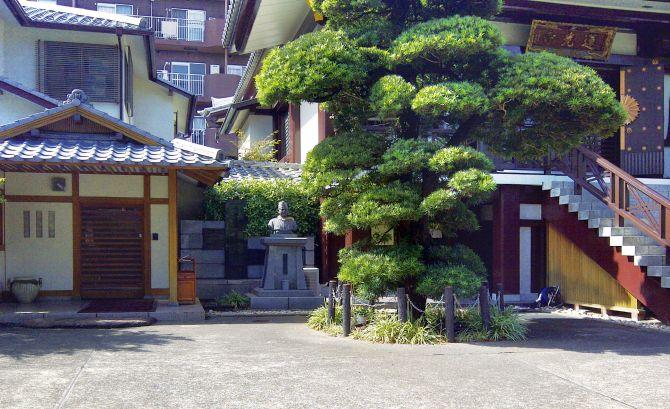
The Renkoji Temple is a lot smaller than other grand Buddhist shrines in Japan. In front of the gate, in a very serene setting, is the bust of Netaji. Aseem Chhabra reports from Tokyo. 

On all my travels abroad, I always look for signs of India. Last week while I was in Tokyo, I heard about a Buddhist shrine where there is a statue of Netaji Subhas Chandra Bose. I knew I had to go there.
Finding online directions to the shrine was not difficult. Despite the language issues, it is easy to find online information about Tokyo in English.
Last year I had taken a couple of friends on a day trip outside Tokyo, to the legendary Japanese filmmaker Akira Kurosawa’s grave. It had taken us a while to find our way. Netaji’s statue is in Tokyo itself. So it had to be easier to get there.

For various reasons I was only able to go to the Renkoji Temple -- where the statue stands -- on the last day of my trip. TheTokyo subway system is quite easy to follow.
Despite the very foreign sounding Japanese names, the subway maps are available in English. There are announcements in Japanese and English. And if one is lucky, one can find an English speaker willing to give directions. The Japanese people struggle with their English, but they are very friendly and polite.
My friend Ben Lopez and I took the Maranouchi Line to the Higashi-Koenji station. Upon exiting, we took a left turn and immediately ran into a South Asian-looking man, who was handing out flyers for an Indian restaurant called Indus.
Turns out Mithilesh Sharma was Nepali, from outside Kathmandu. He had been in Japan for six years. Before that he worked in Noida, outside Delhi. His Hindi was definitely better than his English.

Tuesday, 8 October 2013

Line Corp ropes in Katrina Kaif

Japan-based Line Corporation, a provider of instant messaging service, has roped in Bollywood actress Katrina Kaif to be its brand ambassador for India. Since its launch as a free call and messaging app in June 2011, Line has over 260 million users in 230 countries, including 10 million in India.

The company has also partnered with Sony India to pre-install its instant call and messaging application on select Sony smartphones. Going forward, the company plans to localise its app in Hindi and Tamil. It would also provide localised Bollywood content to its subscribers by partnering with makers of upcoming feature films Krrish 3 and Dhoom 3.

New Honda Jazz and City diesel India launch confirmed

Honda Cars India Limited is soon to bring in a diesel variant of their entry mid-level sedan, City. It will be the new City which will get the diesel engine, and not the existing variant. Apart from this, Honda will also get the new Jazz to India in both petrol and diesel engine variants.
new honda city diesel render

new honda city diesel render
Slated to be launched in Japan at the end of this year, 2014 City sedan will be making its way into India in early 2014. Another new car is in the making in the form of a revamped Jazz, which is already launched in Japan, for a starting price of JPY 1.26 million (approximately INR 8.35 lakh). Price in India will be lesser as Honda Car India will have increased local content on the new Jazz.

Honda City is in its third generation in the country and has seen favor with buyers in the mid sized sedan segment. New Honda City will receive a complete facelift and will come in with two engines in the form of a 1.5 liter i-VTEC and newly developed 1.5 liter i-DTEC, which powers the Amaze sedan. It is the latter which is much in demand. The render above is credit to abesselingSVF’s.

honda jazz diesel india
Honda is confident of extensive growth during the remaining of 2013. The company is pushing ahead sales of Honda Amaze in both diesel and petrol guises in markets of Madhya Pradesh, Chhattisgarh and Vidharba where customers are both price conscious and demand a vehicle that is highly fuel efficient. Honda Amaze is a winner on both counts delivering 25 kmpl and coming in at a competitive pricing. Apart from this, they recently launched the new Brio Exclusive Edition, to capture the attention of buyers as India enters the auspicious festive season.